
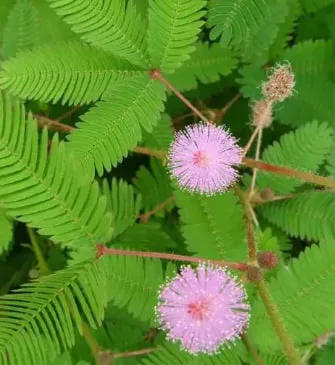
Last spring, I’d only intended to tidy up my messy backyard. But at the local garden center, I stumbled upon a peculiar plant. It sported tiny yellow fluffy balls and leaves as delicate as ferns. The tag read “Mimosa pudica.” Honestly, it looked like a character straight out of a cartoon. On impulse, I bought three plants and casually planted them in the soil by the porch. I thought it would be nice to see them while drinking my morning coffee.
Later, the elderly lady next door—who loves chatting with her plants—peeked over. “Do you know what you’ve planted?” she asked. That moment dawned on me that I might have stumbled upon a treasure. As a floral expert, I must tell you: this is no ordinary weed.
The Language of Mimosa: Gentleness, Hope, and a Symbol of Feminine Strength.
Its scientific name often confuses people, but its adorable common name is more familiar. Its leaves are unique—they fold shut at the slightest touch. This behavior earned it the label “sensitive.” But to us experts, it’s precisely a sign of its wisdom.
The language of the mimosa holds many layers of meaning. It represents far more than just shyness.
- Gentle Strength: The closing of its leaves isn’t retreat, but self-protection. It symbolizes a soft exterior with a principled core.
- Hidden Affection: Historically, gifting a branch of mimosa conveyed “I love you, but I prefer not to shout it from the rooftops.” It embodies a subtle, profound devotion.
- Sunlight and Hope: Those bright yellow flower clusters resemble suns plucked and placed upon the branches. They represent banishing darkness and welcoming warmth.
- Feminine Strength: Globally, it’s the official symbol of International Women’s Day. It embodies solidarity, independence, and the courage to fight for equality.
See how such a small flower holds such a vast world within.
What Occasions Suit Mimosa’s Floral Meaning? Gifting Symbolism Explained.
Mimosa is versatile, making it suitable for a wide range of gifting occasions. You needn’t be confined to specific holidays.
For International Women’s Day, presenting a bouquet of mimosa to female colleagues or family members pays tribute to their strength. This carries deeper meaning than roses. If a friend is navigating a low point or embarking on a new chapter, mimosa is an excellent choice. It whispers: even in harsh conditions, vibrant blooms can emerge.
Sometimes, bringing a small bouquet of mimosa as a housewarming gift is also wonderful. Its honey-like sweet fragrance can refresh the entire room. It’s a thoughtful gesture without being ostentatious.
How to Select and Pair Mimosa Bouquets (Practical Gifting Tips).
To present the perfect mimosa gift, pay attention to these details. These are simple yet effective tips I’ve gathered over the years.
Color pairing matters. Yellow mimosa pairs beautifully with purple-toned blooms. For instance, combining it with lavender or purple irises creates striking contrast and visual appeal. For a softer feel, white tulips work wonderfully, evoking the essence of spring.
Keep packaging simple and natural. Mimosa’s delicate, fluffy blooms risk being overshadowed by overly ornate plastic wrapping. Opt for plain kraft paper or lightweight linen to highlight its organic texture.
Inspect condition carefully. When purchasing, gently touch the tiny yellow fluffy balls. They should feel plump and vibrant.
If they appear brownish or wrinkled, they’re no longer fresh.
Care requires attention too. Mimosa pudica is quite “thirsty.” Upon receiving the flowers, trim the stems at an angle and place them immediately in lukewarm water. Keep them away from heaters or other heat sources, as this can cause petals to dry out and fall off.
Life Lessons Behind the Language of Mimosa Pudica.
This reminds me of my days in the garden.
There was a period when work was particularly rough—projects were stolen, and my spirits hit rock bottom. That afternoon, exhausted, I sat in the yard, lost in thought. Right before me were those few mimosa plants. They swayed gently in the breeze, their little yellow balls looking especially dazzling. Suddenly, I recalled what I’d read: they symbolize “overcoming adversity.”
It struck me as quite remarkable. This flower thrives in barren soil, blooming like miniature suns even under harsh conditions. In that moment, my heart felt lighter. The “sensitivity” spoken of in the language of the mimosa isn’t a weakness. It’s a survival strategy. Close when you must, and bloom freely when the time is right.
I began trimming the branches, arranging them in pots around the house. Though fallen petals scattered the ground, the sweet scent mingling with earthy notes was utterly captivating. Friends visiting always inquired about these flowers. I shared this story with them.
Perhaps I’ve become that person overly devoted to plants. But in this sometimes cold world, having a corner of vibrant garden means security and kindness. It makes the house feel more like home. I no longer chase the perfect lawn; I just want the mimosa to claim this little space.
Sometimes, you just need to remind yourself: Sensitivity isn’t a flaw—it’s how you perceive the world.
Ah, looking at these little flowers, I truly feel that having a bit of peace all your own is better than anything else in life.
